A DIFFERENT TECHNIQUE FOR ARC STUD WELDING
E.O.I. Tecne offers high-quality welding solutions for industrial assembly processes.
How does arc welding work? Arc welders use an electric welding process based on a welding gun where the stud is inserted to act as the electrode of one pole, while the other pole is the surface to be welded. In addition to short arc welding, we offer another type of stud welding using the patented SRM function by Soyer.
In this type of arc welder, the welding arc is rotated using a magnetic field. Through the forced rotation of the arc, SRM arc welders achieve a more uniform fusion of the studs and sheet metal, allowing welding even on thinner materials without perforating the sheet. Moreover, SRM technology also reduces the size of the weld bead.
The main advantages of short arc welders with SRM function are energy savings, cleanliness, and welding precision. Arc welders with SRM function offer greater precision by reducing spatter during welding and feature a smaller fusion area, enabling excellent welds even on vertical surfaces.
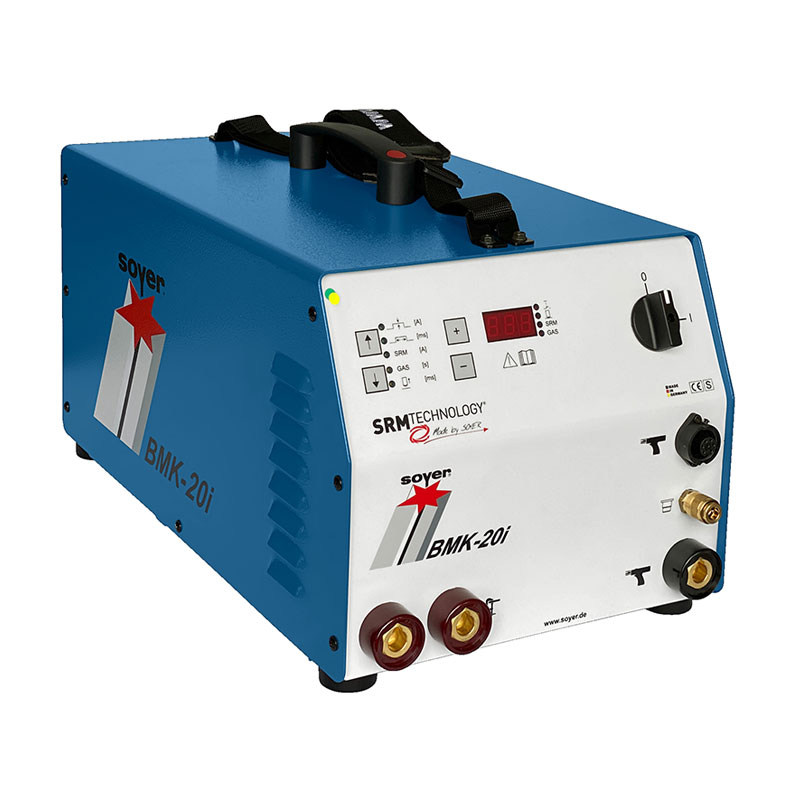
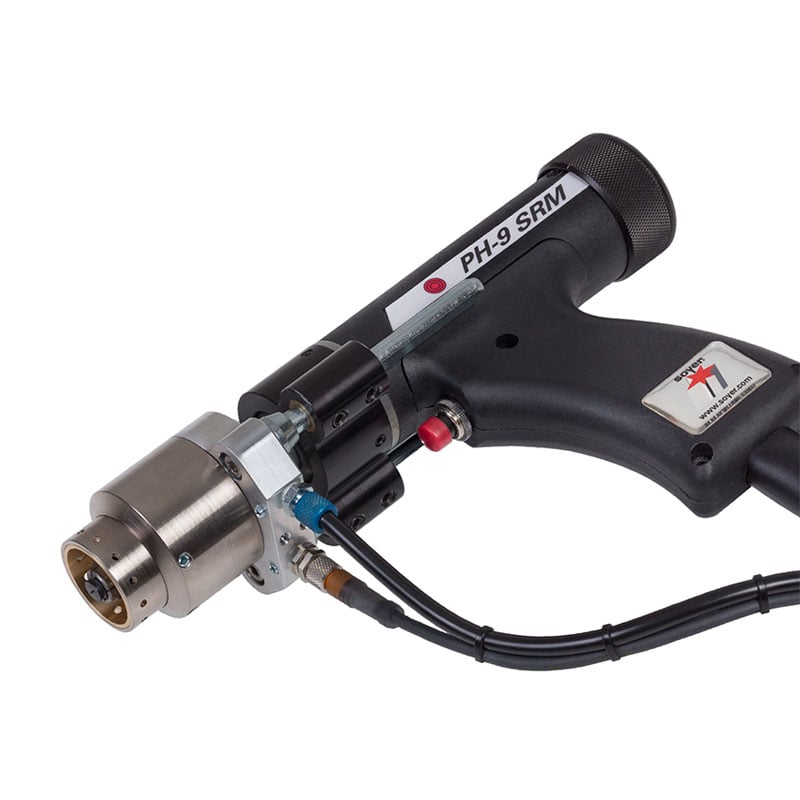
Our stud welding systems enhance weld quality, and the short arc SRM system can be used with our BMK-8i, 10i, 12i, 16i, 20i, and 30i welders paired with our SRM welding guns, which can be used with studs up to M16.
This welding technique offers key advantages such as eliminating the weld bead, allowing the stud threading to be used all the way to the base.
Browse our range of symmetrical radial arc welders (SRM) to find the rotating arc welder best suited to your needs.
Symmetrical radial arc welding enables excellent welding of iron and stainless steel studs and stainless steel nuts, simplifying welding procedures. This technology is a groundbreaking innovation in the field of stud welding.